What to Check When Buying Small Acreage in Elbert County
June 18, 2026
June 18, 2026
Wondering whether a 5-acre or 10-acre parcel in Elbert County is truly a good fit? That question matters more than many buyers expect, because with small acreage, the real value is not just in the number of acres. It is in whether you can build on it, service it, access it, and use it the way you want. If you are comparing land in Elbert County, this guide will help you evaluate the details that can make one parcel workable and another far more complicated. Let’s dive in.
Before you get too attached to a parcel, confirm whether it is actually buildable for your intended use. In unincorporated Elbert County, a building permit requires the property to be appropriately zoned or located in an approved subdivision. The county also states that parcels smaller than 35 acres must go through subdivision review by Community Development Services and the Planning Commission before development.
That is why zoning should be your first stop. Use the county’s official zoning map to confirm the zone district, then compare that district to the county’s land-use table to see whether your intended use is allowed by right, requires special review, needs a minor special use, or is not allowed.
Small acreage can look similar on a listing sheet, but county standards may treat parcels very differently. Elbert County’s dimensional standards list minimum lot areas of 35 acres in A, 20 acres in A-2, 10 acres in AR, 10 acres in RA, 5 acres in RA-1, 2.5 acres in RA-2, 1 acre in R-1, 12,000 square feet in R-2, and 9,000 square feet in MH.
This matters because a parcel’s size alone does not tell you whether it fits the zoning rules. A 5-acre parcel may work in one district and create problems in another, especially if it was created outside current standards or if subdivision status is unclear.
Do not rely only on old listing remarks or informal seller notes. Elbert County adopts its official zoning map annually, so buyers should verify the current map rather than assume prior information is still accurate.
If the property is in a planned unit development, or PUD, setback and development rules may come from the recorded Development Guide Agreement instead of only the base zoning article. That can affect where you place a house, barn, shop, fence, or other improvement.
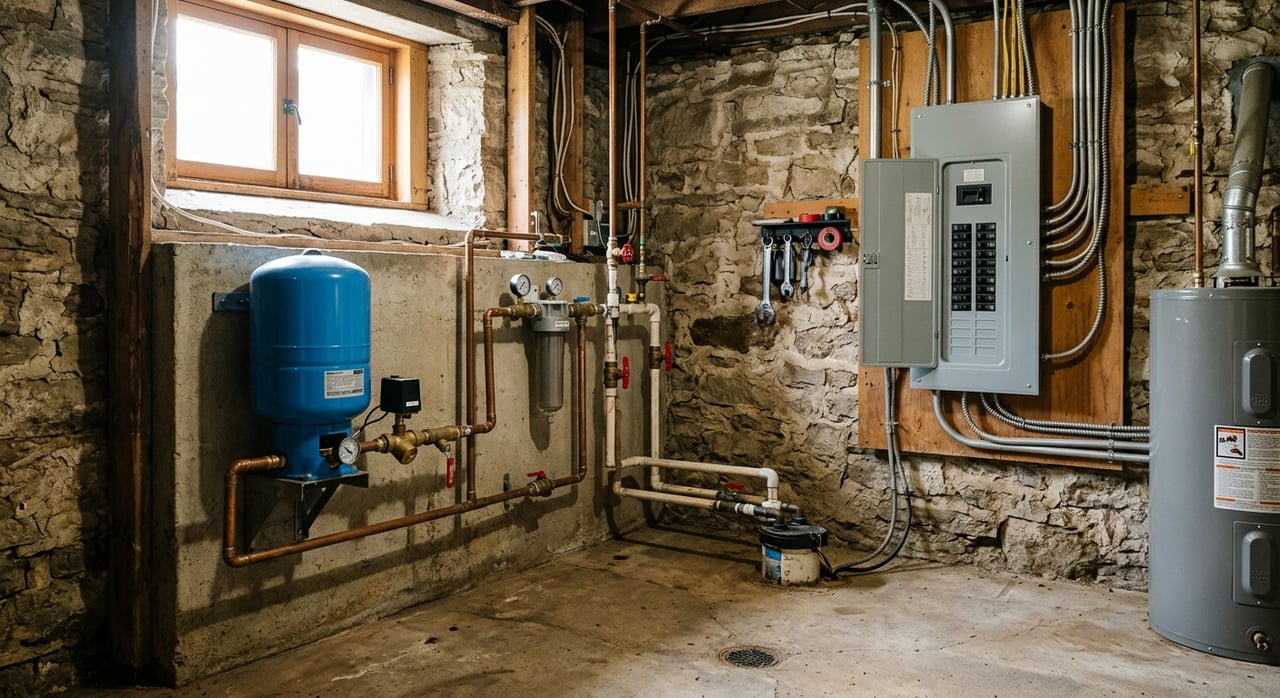
For small acreage in Elbert County, utility questions are not secondary. They are central to whether the parcel works for your plans. If a property depends on private systems, you should treat well and septic feasibility as part of the core evaluation, not something to sort out later.
Elbert County Environmental Health handles septic permits and inspections, and it also offers land-use planning consultation. If septic feasibility is uncertain, that deserves attention before you get too far down the road.
The Colorado Division of Water Resources issues well permits and provides tools to search existing permits. It states that complete new or replacement well applications may take up to 49 days to review, and parcels in the Denver Basin may be subject to additional rules.
That timeline alone can affect your planning. It also helps explain why buyers should not assume a future well permit is automatic just because nearby parcels have wells.
Water supply review goes beyond a simple permit check. The Division of Water Resources reviews water-supply proposals submitted through county land-use processes, and Elbert County’s subdivision regulations require evidence of necessary water for 300 years.
The county’s preliminary plat process also evaluates water sufficiency and utility availability. Just as important, DWR states that it cannot guarantee a particular well permit will be issued before it completes a full evaluation.
If the property will use a private well, you will also be responsible for the safety of that water supply. CDPHE notes that private well owners are responsible for water safety and that private wells are not regulated the same way public drinking water systems are.
Elbert County’s groundwater well monitoring program, which began in 2015 with the USGS, expanded its volunteer network in April 2026 to gather more rural groundwater data. For buyers, that is a practical reminder that groundwater conditions are an active planning issue in this area.
A parcel may look perfect on paper and still become expensive or difficult if access is limited. That is why road access deserves a detailed review early in the process.
Elbert County Road & Bridge offers Residential Access Permits, Private Road Permits, Residential Grading Permits, and related road-use permits. If your property needs a new driveway connection or road improvement, those requirements can shape both cost and timeline.
The county’s 2025 access standards say that a new driveway from private property to an existing graveled county road must include 6 inches of compacted class 6 aggregate base, a 24-foot width within the right-of-way, and at least an 18-inch culvert or equivalent at the ditch flow line. A sketch plan must also be submitted with the access-permit application.
Those details matter because access is not just about whether a road touches the property. It is about whether legal and physical access can meet county standards in a realistic way.
You also need to know where improvements can actually go on the site. County rezoning and exhibit requirements call for legal descriptions, easements, proposed access, topography, floodplains, and existing structures.
In plain terms, a parcel can have enough acreage and still have a limited usable area once setbacks, easements, slopes, or drainage issues are considered. That is often where a surveyor or civil engineer becomes especially helpful.
Once you know a parcel may be buildable and serviceable, the next question is whether it supports your intended lifestyle. This is where many small-acreage comparisons break down.
Two parcels with similar acreage may have very different rules for animals, outbuildings, or future changes in use. If you want a hobby farm setup, horse property features, or room for additional structures, this step is essential.
Elbert County’s Article XIV sets district-specific rules for noncommercial household pets, domestic hoofed livestock, poultry, fowl, and livestock. For example, R-1 allows two equine, while R-2 allows no large animals such as horses, cattle, sheep, or goats.
The county also states that swine are not allowed on parcels 4.999 acres or less. In RA, RA-1, RA-2, AR, and A-2 zones, and on nonconforming parcels under 35 acres, the density limit is one animal unit per one-half acre.
Article XIV also makes clear that small livestock and poultry rules vary by district. Animals must also be properly housed and kept within setback requirements.
That means a coop, paddock, or barn may be workable on one parcel and limited on another, even if the acreage appears similar at first glance. For buyers with specific land-use goals, this is a major comparison point.
County approval is only part of the picture. Elbert County states that it does not enforce HOA rules or neighborhood covenants, and a county permit does not authorize work that violates private CC&Rs.
So even if zoning appears favorable, private restrictions may still limit barns, fences, livestock, or outbuildings. The county’s permit pages include a Homeowners Association and Covenants Statement form, which reinforces how important these private documents can be.
If the parcel is part of a common-interest community or subject to recorded restrictions, confirm those rules separately. This is especially important if you are buying for a specific use, such as keeping animals, adding a detached shop, or building in phases.
A property can check the county boxes and still conflict with private restrictions. That is why reviewing recorded covenants early can save you time, money, and frustration.
If you are thinking beyond a simple home build, future use flexibility matters. Elbert County’s rezoning criteria include consistency with the comprehensive plan, compatibility with surrounding land uses, impacts to public services, environmental effects, traffic impacts, and overall health and safety.
The county also notes that rezoning requests without a proposed use are generally not considered because water, traffic, and environmental impacts cannot be evaluated. In other words, future flexibility is not something to assume.
Special uses by review can be conditioned and may be revoked if conditions are not upheld. Site development plans are reviewed administratively by Community Development Services, and building permits must be obtained within one year of approval or that approval can be rescinded.
If your long-term vision includes more than a standard residence, it is wise to evaluate those rules up front. A parcel that works for today may not support your future plan without additional approvals.
Small-acreage due diligence often works best as a team effort. If zoning, subdivision status, special-use review, or site-development requirements are unclear, bring in Elbert County Community Development Services early.
If boundaries, access points, easements, topography, or floodplain issues are hard to interpret, a surveyor or civil engineer can help clarify the true buildable area. If the property relies on private water or wastewater systems, well and septic professionals should be part of the conversation early as well.
For parcels with HOA documents, recorded covenants, or PUD rules, it may also make sense to contact the HOA or review those restrictions carefully with qualified guidance. The key is not to wait until late in the process to answer questions that affect whether the land fits your goals.
If you want a clean framework for comparing small-acreage properties in Elbert County, ask four questions in order: Can it be built? Can it be serviced? Can it be reached? Can it be used the way you want?
Parcels that match on zoning, water source, access type, and private restrictions are usually more comparable than parcels that simply share a similar acre count. That approach can help you make a more confident decision and avoid surprises after you go under contract.
If you are sorting through acreage options in Elbert County and want a practical second set of eyes on the process, Galen Becker can help you evaluate the details that matter and move forward with more clarity.
Stay up to date on the latest real estate trends.

Whether buying, selling, or investing, Galen Becker provides tailored strategies and expert support to achieve your real estate goals.