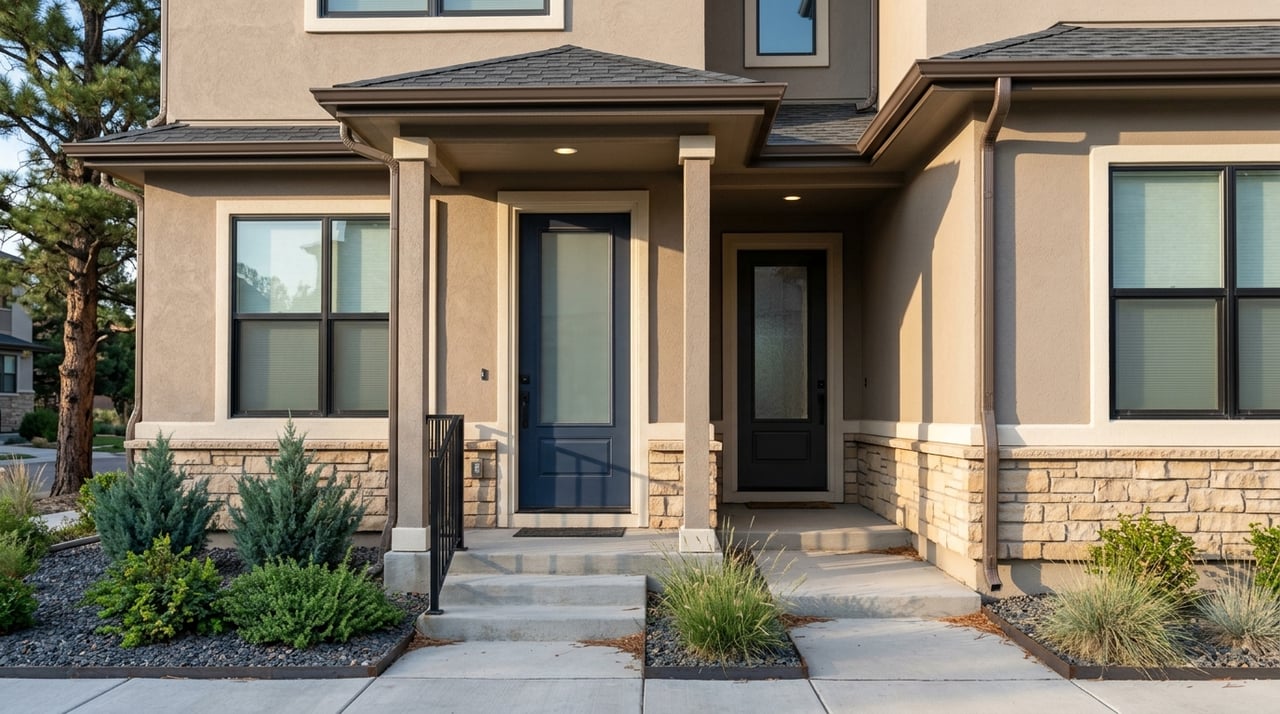
Low-Maintenance Living: Condos And Townhomes In El Paso County
July 23, 2026
July 23, 2026
Want a home that cuts down on yard work, exterior upkeep, and weekend to-do lists without taking you out of El Paso County’s housing market? For many buyers, condos and townhomes offer a practical path to homeownership with a smaller maintenance load and, often, a lower entry price than a detached home. If you are weighing the tradeoffs, this guide will help you understand pricing, ownership, HOA responsibilities, and what to check before you buy. Let’s dive in.
In El Paso County, attached homes can be an appealing middle ground between renting and buying a detached house. Redfin currently shows 278 condos with a median listing price of $255,000 and 491 townhouses with a median listing price of $375,000. By comparison, the countywide median sale price across all home types is about $479,000.
That pricing gap helps explain why condos and townhomes get attention from first-time buyers, downsizers, and relocation buyers. A condo sits roughly $224,000 below the county median, while a townhome sits about $104,000 below it. If your goal is to lower your purchase price while still finding a home in a convenient area, attached housing may deserve a closer look.
Attached housing in El Paso County is not one-size-fits-all. Current condo listings range from a 2-bedroom, 2-bath, 984-square-foot unit with a private balcony and detached 2-car garage to a 3-bedroom, 3-bath, 1,892-square-foot unit with multiple walkouts and two garages. There are also ranch-style condo layouts with features like covered patios and wet bars.
Townhomes also cover a wide range of sizes and layouts. Current examples include 2-bedroom homes around 1,005 square feet, 2-bedroom, 2.5-bath homes around 1,488 square feet, and 3-bedroom homes around 1,624 to 1,692 square feet. Many include decks, patios, garages or carports, and in-unit laundry.
That variety matters if you are trying to match a home to your lifestyle. You may be able to find a smaller, simpler setup for easier living, or a larger attached home that still gives you usable space for guests, hobbies, or working from home.
A condo is not just a style of home. In Colorado, it is a legal ownership structure within a common interest community, where part of the real estate is owned separately and the rest is owned in common by the unit owners.
That means you should not rely only on the listing description when a property is labeled a condo. The recorded declaration and plat define what you actually own and what the homeowners association maintains. This is one of the most important differences between attached housing types, because the legal documents control the details that affect your day-to-day ownership.
Townhomes in El Paso County often feel more like small attached houses. You will commonly see 2 to 3 bedrooms, multiple bathrooms, outdoor spaces like patios or decks, and attached or nearby parking.
Even so, the maintenance setup can vary from one community to the next. Some townhome associations handle more exterior work, while others leave more responsibility with the owner. The governing documents are what tell the full story, so it is smart to review them carefully before you commit.
Low-maintenance does not mean no-maintenance. In most condo and townhome communities, you are trading some personal control for shared upkeep and less exterior work.
Under Colorado’s Common Interest Ownership Act, the association generally handles maintenance, repair, and replacement of common elements, while the owner handles the unit unless the declaration says otherwise. The Colorado Department of Regulatory Agencies also notes that associations commonly control exterior maintenance in condos and townhomes. That can mean less mowing, fewer exterior repairs on your to-do list, and more predictable day-to-day upkeep.
For many buyers, that tradeoff is the whole point. If you travel often, prefer a lock-and-leave setup, or simply do not want to spend weekends managing a yard, attached housing can make homeownership feel more manageable.
HOA dues are a key part of the condo and townhome equation. In Colorado, regular assessments may be paid monthly, quarterly, or annually, and they typically help fund things like maintenance, landscaping, legal fees, registration fees, insurance, and other operating costs.
That means a lower list price does not tell the whole cost story. Part of the savings may come from the purchase price, while part of your housing expense shifts into monthly dues and shared community costs. You will want to look at the full payment picture, not just the mortgage.
Not all HOA costs are routine. Special assessments are separate charges that may be used for repairs, replacements, unexpected large expenses, new construction, or reserve funding.
Colorado does not set one universal timetable for special assessments. Instead, the declaration and governing documents matter. This is why two attached homes with similar list prices can feel very different financially once you review the association’s budget health and upcoming needs.
DORA says associations must follow a budget process and provide annual disclosures that include the operating budget, current assessments, financial statements, reserve amounts, insurance policies, bylaws, articles, rules, meeting minutes, and governance policies. Colorado law does not require reserve studies for existing communities, but it does require a reserve-study policy that explains when a study will occur and whether there is a funding plan.
Associations formed after July 1, 1992 must maintain certain insurance policies to the extent reasonably available, including property insurance on common elements and commercial general liability coverage. In some cases, fidelity insurance is also required.
This insurance structure is one reason attached living can feel simpler. Some of the larger community-level risks and responsibilities are handled at the association level. Still, you should confirm what the HOA insures and what you need to insure on your own, because those details affect your budget and peace of mind.
If your condo or townhome includes a small yard, patio area, or courtyard that you are responsible for, Colorado law offers some flexibility. Associations may not prohibit xeriscape or drought-tolerant landscaping on property the unit owner maintains, although they can still apply design or aesthetic guidelines.
That can be a practical advantage in El Paso County. If you want a home that is easier to care for and more water-wise, a smaller outdoor area may be simpler to maintain than a larger detached-home yard.
If you plan to use FHA financing for a condo, the project itself may need to meet approval standards, or the unit may need to qualify for single-unit approval. Those standards can involve insurance coverage, financial condition, title, pending legal action, and property condition.
In plain terms, a condo can look affordable at first glance but still create financing challenges if the project is weak or under-documented. This is one reason it helps to work with a local agent who can help you spot red flags early and keep communication moving between the lender, listing side, and HOA.
Condos and townhomes often make sense for buyers who want a lower entry price and less exterior upkeep. They can also be a strong fit for downsizers who want a smaller footprint and simpler home care.
They are also worth considering if you like the idea of a lock-and-leave home or shared amenities such as pools or clubhouses. On the other hand, if you want full control over exterior finishes, landscaping, or appearance rules, a detached home may be a better match.
There is no one right answer for everyone. The best fit usually comes down to how you want to spend your time, how much control you want over the exterior, and how comfortable you are with shared rules and shared costs.
Due diligence matters more in attached housing than many buyers expect. DORA recommends reading the declaration, checking the physical condition of the community for deferred maintenance, asking about litigation, and confirming that your lender is comfortable with HOA questionnaires.
There is no central repository for governing documents in Colorado, so buyers usually get them through the seller and listing side once a contract is in place. Owners can request records, but associations may require a written request with reasonable detail, at least ten days’ notice, and a reasonable copying fee.
A community can look tidy from the curb and still have hidden financial stress. DORA specifically points to chipping siding, failing balconies, or a neglected roof as possible signs of deferred maintenance.
Those issues matter because deferred maintenance can lead to future special assessments. In other words, you may be trading yard work for the risk of larger shared repair costs later. That does not mean you should avoid attached housing, but it does mean you should look past the kitchen finishes and ask deeper questions.
Before you make an offer on a condo or townhome in El Paso County, it helps to ask practical questions like these:
Those answers can matter just as much as square footage, bedroom count, or interior updates. When you understand both the home and the association, you can make a much more confident decision.
If you are comparing condos, townhomes, and detached homes in El Paso County, the right choice usually comes down to your budget, maintenance preferences, and long-term plans. A well-chosen attached home can offer affordability, convenience, and a simpler ownership experience, especially when you know what to look for upfront. If you want help sorting through the tradeoffs and finding the right fit, Galen Becker is here to help.
Stay up to date on the latest real estate trends.
Whether buying, selling, or investing, Galen Becker provides tailored strategies and expert support to achieve your real estate goals.